
It usually goes like this. You boost a few posts or set up a campaign at ₹300 a day. A week later you’ve spent ₹2,000, got a handful of likes and two enquiries, and you decide that “ads don’t work for our business”.
Sometimes that’s true. But very often the ads never had a fair chance, because of how Meta’s delivery system learns. Once you understand that one thing, most of the frustration makes sense.
The learning phase, in plain words
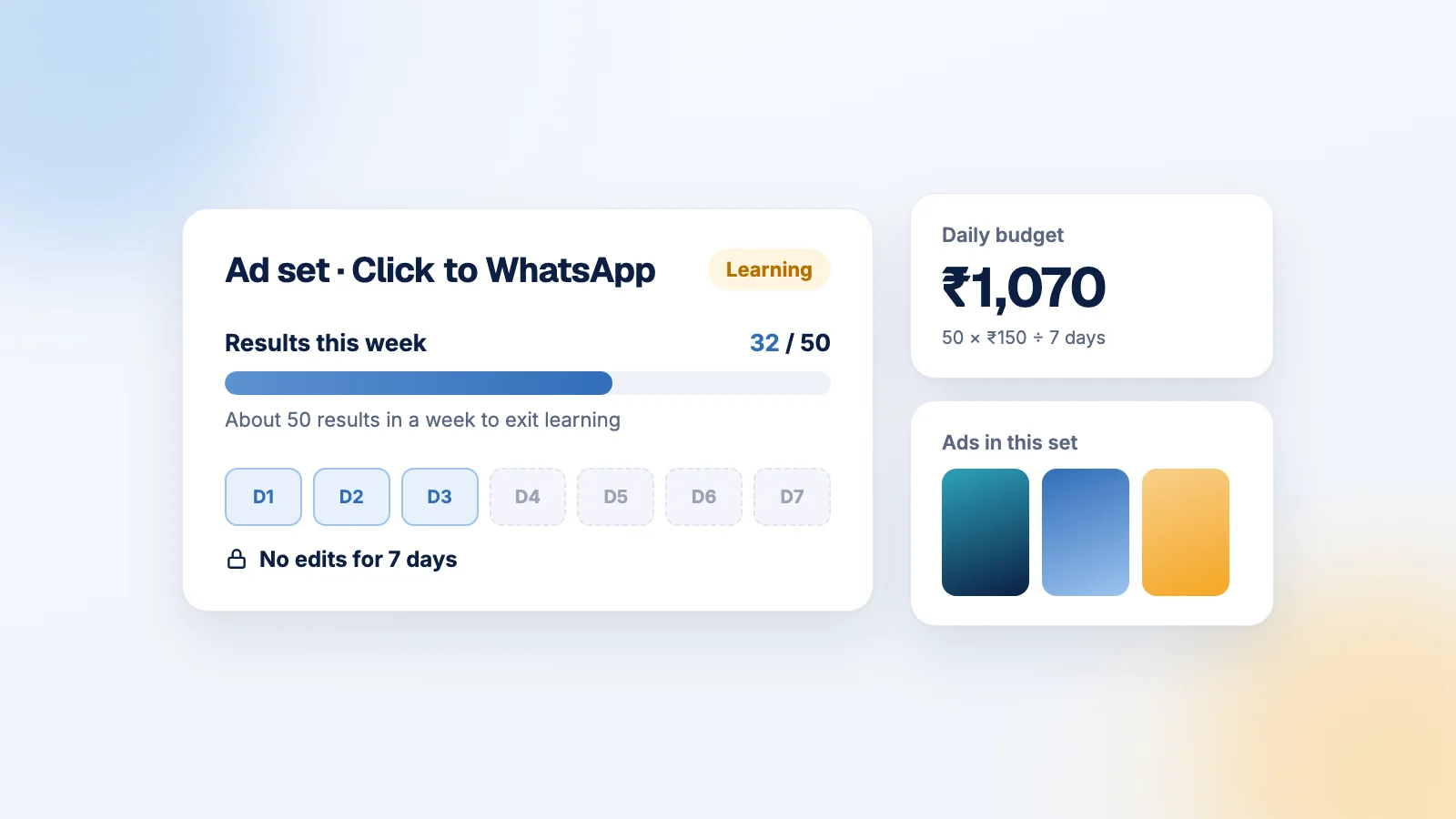
When you create a new ad set, or make a big change to one, Meta’s system enters a learning phase. It’s working out who to show your ad to. According to Meta, an ad set leaves the learning phase once delivery is stable, which usually happens after about 50 results in the week after the last significant edit (Meta Business Help Centre).
A “result” is whatever you told Meta to optimise for: a purchase, a lead form, a message, a landing-page view.
During learning, results are shaky and cost more. If an ad set can’t get enough results to finish learning, Ads Manager marks it “Learning limited”. That’s the label a lot of small budgets quietly live under.
Meta’s own advice for this phase is worth taking seriously:
- Don’t edit during learning. Edits reset it.
- Avoid unnecessary edits later too, because big changes can send an ad set back into learning.
- Don’t create lots of ads and ad sets. Combining similar ad sets combines what the system learns.
- Use a realistic budget, and avoid frequent budget changes. Very small or inflated budgets give the system a poor picture of who to target.
The maths behind most “failed” campaigns
If the system needs about 50 results a week, your budget has to be able to buy them:
Weekly budget ≈ 50 × what one result costs you
Say a lead from a form costs around ₹150. Fifty leads a week is ₹7,500, or roughly ₹1,070 a day. Run that campaign at ₹300 a day and it will almost certainly sit in “Learning limited”, with costs that look worse than they really are.
So what if ₹1,000 a day isn’t in the budget? Two honest options:
- Optimise for something cheaper that happens more often. People start WhatsApp chats and visit landing pages far more often than they buy. You can reach about 50 of those a week on a small budget, then qualify people in the conversation.
- Put all your money in one place. One campaign, one ad set, two or three ads, instead of five ad sets at ₹100 a day each where none of them learns anything.
These are rough estimates. Your real cost per result only shows up after the first week or two, so redo the maths with real numbers.
A first campaign worth trying
For most local businesses and D2C brands in India, a good first campaign is click-to-WhatsApp. People tap the ad and land in a chat with you.
Why it works well on a small budget: starting a chat is easy and frequent, which helps the learning phase. There’s also a bonus if you’re on the WhatsApp Business Platform. A conversation started from a click-to-WhatsApp ad opens a 72-hour window in which all messages are free (Meta for Developers). Our WhatsApp Business guide has more on that.
How we’d set it up:
- Objective: engagement or leads, with WhatsApp conversations as the result.
- Audience: your city or delivery radius, and broad age and interest settings. Let the system find people. Narrowing it to “women 25–34 in Koramangala who like baking” on ₹500 a day starves the learning.
- Creative: two or three ads. For example, one short vertical video (a Reel you’ve already made) and one carousel of your bestsellers. Your best organic posts are usually your best ads; see what’s working on Instagram.
- Copy: one clear offer and one next step. “WhatsApp us for this week’s menu and prices.”
- Budget: use the maths above. Then leave it alone for seven days. This is the hardest part.
After the first week
Look at three things. What you paid per conversation started. How many of those chats turned into real enquiries or orders (label them in WhatsApp so you can count). And the cost per real enquiry: spend divided by genuine enquiries. Compare that with what an enquiry is worth to you (there’s a worked example in the five numbers to track).
Then change one thing, like swapping out the weakest ad, and give it another week.
Common mistakes
Boosting random posts with no clear goal or next step. Editing every day because the first two days looked expensive (that’s just the learning phase doing its job). Splitting ₹500 a day across five ad sets. Sending people to a slow website when they’d much rather just message you. And not tracking where enquiries come from, so nobody knows whether the ads paid for themselves.
More often than not, “ads don’t work for us” really means “our ads never finished learning”. Give the system enough budget for about 50 results a week, pick a result that happens often enough, keep the setup simple, and hold your nerve for seven days.
Sources
- Meta Business Help Centre, “About the learning phase”
- Meta for Developers, “Pricing on the WhatsApp Business Platform”
We checked every rule and figure in this article against Meta’s own documentation on 25 September 2026.