
You’ve seen these posts. “In today’s fast-paced world…” “Elevate your experience…” “Unlock the power of…” Three emojis, five hashtags, and not a single detail that tells you which business wrote it.
AI writing tools have gone from novelty to normal very quickly. HubSpot’s 2026 State of Marketing report found that 80% of marketers use AI to create content and 75% use it for media production, and 61% believe AI is the biggest disruption in marketing in 20 years (HubSpot).
The same report points out the catch: as AI floods feeds with content, most of it is average, and brands without a clear point of view get lost. For a small business the risk isn’t that AI is too weak. It’s that your posts start sounding like everyone else’s.
It doesn’t have to be that way. The trick is being clear about which parts AI does and which parts stay with you.
What Google actually says
If you publish on a website, this matters. Google’s position is that it rewards high-quality content, however it’s produced. What it looks for is original, helpful content written for people, which shows experience, expertise, authoritativeness and trustworthiness (Google Search Central).
What Google does penalise is using automation mainly to manipulate search rankings. Its spam policies specifically mention “scaled content abuse”, which includes using generative AI to churn out lots of pages without adding value (Google Search spam policies).
So: using AI to help you write is fine. Mass-producing filler isn’t. And “AI humanizer” tools that shuffle words around to fool AI detectors don’t change that. Google is judging whether the page is useful, not which tool typed it.
Give AI the repetitive work
These jobs are repetitive, low-risk and easy to check:
- first drafts from a clear brief (captions, product descriptions, email outlines)
- options: five hooks for the same post, three headlines for an ad
- adapting one idea into different formats, like turning a blog post into a carousel outline and a WhatsApp message (more on that)
- summaries, like the common themes across your last fifty Google reviews
- clean-up: grammar, shortening, or a first Hindi translation that a native speaker then checks
Keep these for yourself
Your point of view. What you believe about your craft, what you’d never do, why you started. AI averages everyone’s opinions; customers pick you for yours.
Your real stories. The customer who drove from Nashik for your cake. The batch you got wrong and what you changed. AI can tidy these up, but it can’t invent them honestly.
Facts and numbers. Prices, dates, claims, statistics: check every one against a real source, every time. AI tools can state wrong facts with total confidence.
Sensitive replies. Complaints, refunds, anything emotional. A person reads these and a person sends them.
And the final yes. Someone who knows the business approves every post before it goes out.
A five-step workflow
1. Brief it properly. Give the tool your brand voice guide, who the post is for, the one thing it should say, and a real example of your own writing. A vague brief gets a vague post.
2. Ask for options, not answers. Get three to five versions or hooks, and pick the best starting point instead of accepting the first draft.
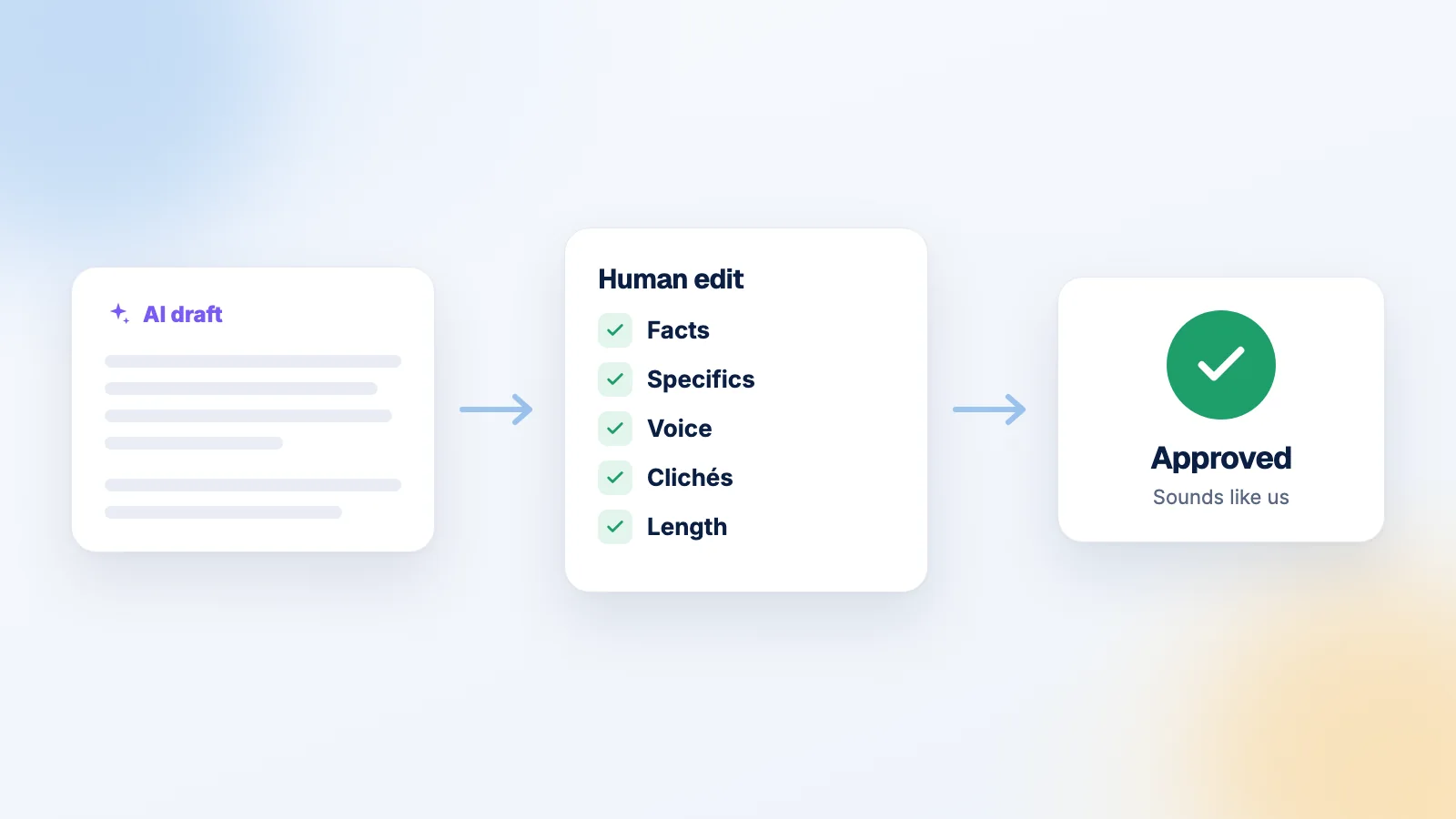
3. Edit like a human. Run every draft through a short checklist:
| Check | Ask yourself |
|---|---|
| Facts | Is every price, date, number and claim correct, with a source? |
| Specifics | Did we add a detail only we’d know: a name, a place, a number? |
| Voice | Would we actually say this out loud to a customer? |
| Filler | Did we cut “in today’s fast-paced world”, “game-changer”, “unlock”? |
| Length | Can we cut a fifth of it without losing anything? (Usually, yes.) |
4. Approve before publishing. One person signs off. In AIMPLE AI, for instance, publishing with approval is included in every plan, so nothing goes live until a person says yes.
5. Measure and feed it back. Track what works using the five numbers that matter, and add your best-performing posts to the examples you give the tool next time.
What a human edit looks like
The AI’s first draft: “Elevate your mornings with our premium, artisanal coffee blends, crafted to perfection for the discerning coffee lover.”
After a human edit: “We roast on Tuesdays and ship on Wednesdays, so your beans are never more than a week old. This week: a chocolatey single-origin from Chikmagalur.”
The second one is specific, you can check it, and it sounds like a real roastery. That’s because a person added what only they knew.
Sources
- HubSpot, “2026 State of Marketing Report”
- Google Search Central Blog, “Google Search’s guidance about AI-generated content”
- Google Search Central, “Spam policies for Google web search”
We checked every figure and policy point in this article against the original source on 25 September 2026.