
Read these two captions for the same product:
“We are delighted to introduce our latest range of premium handcrafted cotton kurtas, designed to offer unparalleled comfort.”
“New kurtas are in! Soft cotton, hand block-printed in Sanganer, and actually breathable in May.”
Both are correct. Only one sounds like a person. And the second one does more selling: it’s specific, it’s local, and it answers the question every customer has in summer.
The difference is voice. When one person writes everything, a brand sounds consistent by accident. The moment a second person, a freelancer or an AI tool starts writing, it doesn’t. You end up sounding like three different companies.
A brand voice guide fixes that. It shouldn’t be a 40-page PDF. One page that anyone can read in five minutes is far more useful, because people actually read it.
Is this worth an afternoon? Yes.
Tone isn’t decoration. The Nielsen Norman Group tested pairs of almost identical web pages where only the tone changed. Tone measurably affected how friendly, trustworthy and desirable people found the organisation. Casual, conversational and enthusiastic tones did best in their tests, and how trustworthy a brand seemed was a strong predictor of whether people would recommend it (NN/g).
That doesn’t mean everyone should be casual. A hospital shouldn’t sound like a streetwear brand. It means tone is a choice with consequences, so make it on purpose.
A quick definition before we start. Voice is your personality, and it stays the same everywhere. Tone is how that personality adjusts to the moment. You’re more playful in a Reel than in a reply to an angry customer, but it’s still recognisably you.
Step 1: Place yourself on four scales
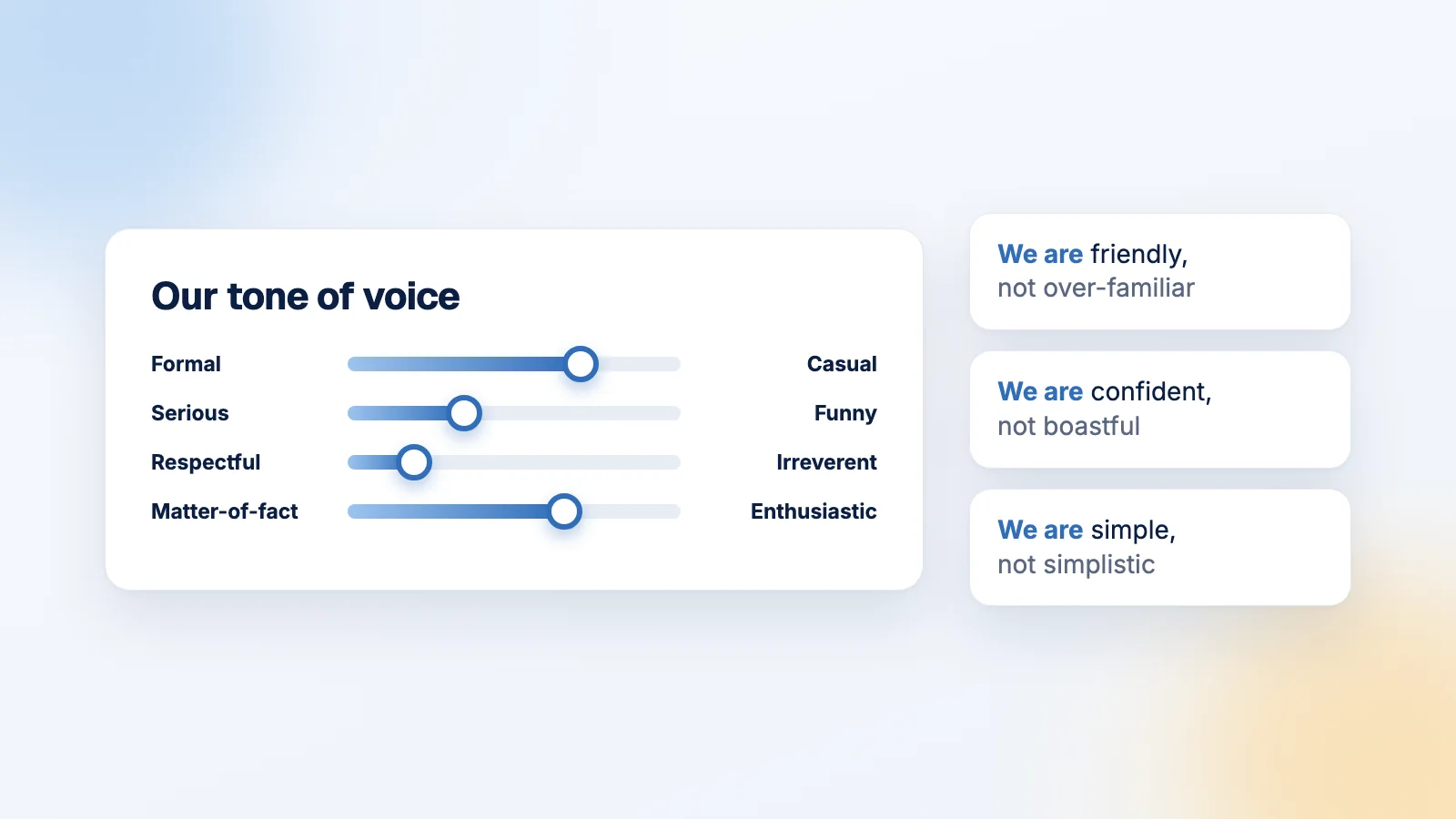
NN/g describes tone along four scales (NN/g): formal to casual, serious to funny, respectful to irreverent, and matter-of-fact to enthusiastic.
Give yourself a number from 1 to 5 on each. A physiotherapy clinic might be casual 3, funny 2, irreverent 1, enthusiastic 3: warm, but never jokey about someone’s pain. A streetwear label from Bengaluru might go 5, 4, 4, 5. Neither is wrong.
Step 2: Write three “we are… not…” lines
These are the heart of the guide, because they draw a line on both sides:
- We’re friendly, not over-familiar.
- We’re confident, not boastful.
- We’re simple, not simplistic.
Add one real example sentence under each, so people can see what you mean.
Step 3: Words to use, words to avoid
| We say | We don’t say |
|---|---|
| “book a slot”, “WhatsApp us” | “leverage”, “synergy”, “solutions” |
| the words customers use for their problem | our internal jargon and product codes |
| specific numbers (“delivered in 48 hours”) | vague claims (“fast turnaround”) |
The best source for the left column is your customers. Copy their exact phrases from reviews and WhatsApp chats. If they say “tiffin” and you say “meal subscription”, you’re the one who has to change.
Step 4: Rewrite three real posts
Nothing teaches voice like a before and after. Pick three things you’ve actually published and rewrite them:
Before: We are pleased to announce the launch of our new range of premium skincare solutions.
After: Our new sunscreen is here. Light, no white cast, and made for Indian summers.
Step 5: Note how tone shifts by channel
| Channel | How the tone shifts |
|---|---|
| Most playful; short sentences; emoji only when they add meaning | |
| Same voice, a bit more matter-of-fact; lead with the insight | |
| Personal and short, like the owner typing | |
| Replies to complaints | Most serious and respectful. No jokes, ever |
Step 6: Write down your language rules
Plenty of Indian brands speak to customers in more than one language, or a mix of them. Write the rule down so nobody has to guess. For example: English captions on Instagram, Hinglish is fine in Reels and on WhatsApp, and Marathi for Ganeshotsav posts.
The one-page template
Copy this and fill it in:
- Who we talk to: one or two plain sentences about your customer.
- Our voice in three lines: we’re ___, not ___ (three times).
- Tone scores: formal–casual /5, serious–funny /5, respectful–irreverent /5, matter-of-fact–enthusiastic /5.
- Words we use / words we avoid: five of each.
- Three before/after examples.
- Channel notes: one line per channel.
- Language rules.
Put it where people write
A voice guide in a Google Drive folder nobody opens does nothing. Pin it in your team’s WhatsApp group. Paste it at the top of every brief you send a freelancer. Give it to any AI tool you use, too. AIMPLE AI, for instance, builds a brand profile from your website and files so drafts start closer to your voice, but a human still has to check the result against the guide.
Revisit it every six months, or sooner if your customers change.
Sources
- Nielsen Norman Group, “The Impact of Tone of Voice on Users’ Brand Perception”
- Nielsen Norman Group, “The Four Dimensions of Tone of Voice”
We checked the research findings in this article against the original sources on 25 September 2026.