
Every few months someone on Instagram announces that “carousels are back” or that “only Reels matter now”. Both are partly right, which is exactly why small business owners end up confused.
The easier way to think about it: each format does a different job. Once you see that, the numbers start making sense.
First, the numbers
Socialinsider publishes engagement benchmarks from brand accounts on Instagram. Their 2026 report (Socialinsider, 2026) says:
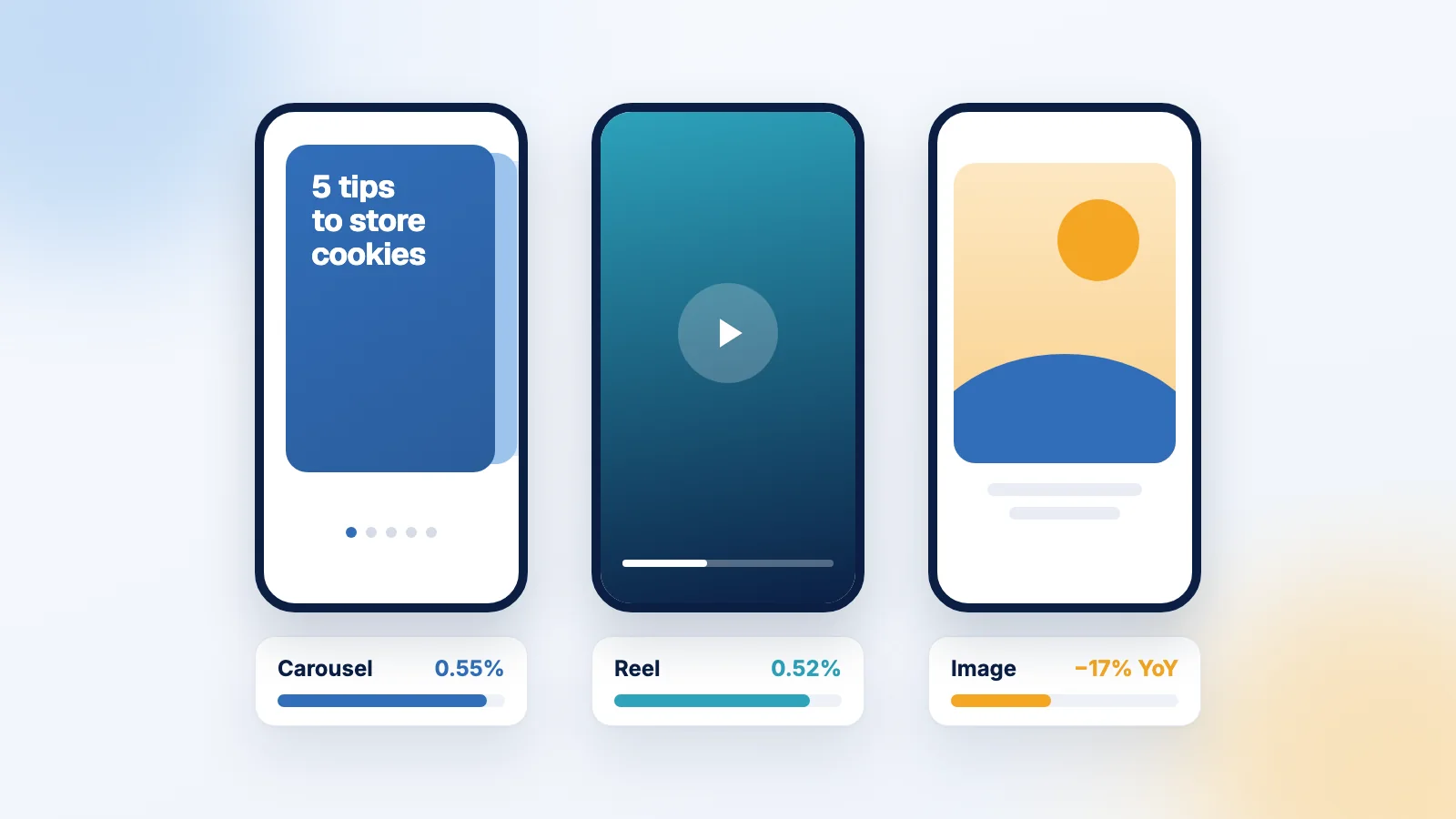
- Carousels are still the strongest format, with an average engagement rate of 0.55%. They also get the most saves and views, whatever the size of the brand.
- Reels are close behind at about 0.52%. Brands posted 33% more Reels than a year earlier, which is probably why Reels no longer give you an automatic boost. Everyone’s doing them.
- Single images keep slipping. Their engagement fell 17% year on year.
Engagement is also falling across the board. Instagram’s overall engagement rate dropped about 24% in a year. In the second quarter of 2026 it was 0.50% for carousels, 0.48% for Reels and 0.33% for images.
Two quick conclusions. The gap between carousels and Reels is small; the gap between those two and single photos is not. And because averages keep falling, comparing yourself with an industry benchmark will mostly make you feel bad. Compare this month’s posts with last month’s instead.
Which format for which job?
Carousels are for teaching and proof. People save them to read later, and saves are a strong signal. “5 ways to keep cookies fresh for gifting”, “before and after: 3 kitchen makeovers”, a price list people will want to come back to.
Reels are for being discovered. They’re how people who don’t follow you yet find you. The morning bake from start to finish in 20 seconds. A saree being draped. The founder explaining one common mistake, straight to camera.
Single photos are for news. A new product, a price, a date, a “we’re closed on Monday”. Use them when the picture itself is the message.
The rule that changed in April 2026
This one is important. In April 2026 Instagram extended its originality protections, which already applied to Reels, to photos and carousels. Accounts that regularly repost content they didn’t create are no longer eligible to be recommended across the app, including in feed recommendations and on the Discover tab (TechCrunch, 30 April 2026).
Instagram counts something as original if you made it yourself, or if you’ve materially changed someone else’s content by adding your own commentary, voiceover, text or perspective. Slapping a watermark on it, speeding up a clip, or posting a screenshot of someone’s post “with credit” doesn’t count.
Honestly, for most small businesses this is good news. Your own product photos, messy behind-the-scenes clips and customer stories are exactly what Instagram now wants to push. The pages that grew by reposting trending memes with a logo in the corner are the ones that should worry.
A mix that works for most small brands
If you’re posting four times a week (here’s why four is a sensible number):
- two carousels, one that teaches something and one that proves something (a review, a result, a before/after)
- one or two Reels from behind the scenes
- a single photo only when there’s actual news
Look at your own numbers once a month and shift effort towards whatever is working for your audience. A home-decor brand might find Reels win every time; a tax consultant might find carousels do all the heavy lifting.
A few things that make each format work
For carousels, put the promise on the first slide, not your logo. “Your cake is dry for one reason” gets swipes; “Baking Tips by Sweet Crumbs” doesn’t. One idea per slide, text big enough to read on a phone, and make the last slide worth saving: a checklist or a summary.
For Reels, the first two seconds decide everything, so start with the most interesting moment. Add captions, because a lot of people watch on mute (on the metro, at the office, in a waiting room). Shoot vertically on your phone in good daylight. It doesn’t need to look like an ad; it needs to look real.
For single photos, write the caption the way you’d message one customer on WhatsApp, and tell them what to do next: “DM us to book”, “orders close Friday”.
Sources
- Socialinsider, “2026 Instagram Organic Engagement Benchmarks”
- TechCrunch, “Instagram cracks down on content aggregators” (30 April 2026)
We checked every figure in this article against the original source on 25 September 2026.